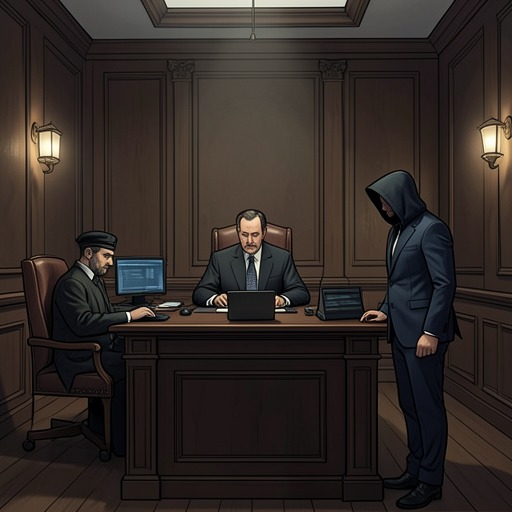
The anonymous letter to Judge Stanton
The Brass VerdictThe anonymous letter to Judge Stanton is a warning about the identity of juror number seven, and its importance lies in the gap it exposes between the official jury record and the person actually sitting in the courtroom. A folded, unmarked sheet gives Judge Stanton a testable lead: check the juror’s employment and fingerprints. The ensuing inquiry establishes that the warning points to a real impersonation, turning an anonymous allegation into a concrete crisis for the Walter Elliot trial.
Discovery and Physical Form
The letter reaches Judge Stanton’s office on Thursday, but he does not open it until after court on Friday, during an end-of-week catch-up session. By Monday, he has considered how to proceed and consulted other judges. When he informs Mickey Haller and Jeffrey Golantz that there is an unusual, still-developing matter of juror misconduct, the letter is already more than a private note: it has become a procedural problem that the court must address without compromising the panel.
Its physical details are spare. Judge Stanton unfolds a sheet of paper he has kept beneath his hands and tells counsel not to touch it. The page appears to have come from a laser printer; aside from two creases where it was folded, it bears no other markings. The envelope has no return address, and its postmark is Hollywood. These details provide no author, motive, or direct proof of the allegation, but they preserve possible avenues of examination. Judge Stanton says the sheriff’s laboratory will inspect both the note and the envelope.
The Warning and Its Immediate Effect
The letter tells Judge Stanton that juror number seven is neither the person the court believes him to be nor the person he claims to be. It directs the judge to check Lockheed and the juror’s fingerprints, and says the man has an arrest record. Rather than supply a full explanation, it points toward records that might confirm or refute the claim. That compressed form makes the message a lead, not a verdict: its author remains unknown, and the information must be tested.
The warning immediately creates competing interpretations. Golantz objects that the defense might be trying to remove a juror through a ploy and insists that counsel be present for any questioning. Haller objects to the accusation. Judge Stanton clarifies that he has not spoken to juror seven; he had intended to raise the matter with counsel that morning. But the juror has failed to appear. His absence makes the letter’s claim more urgent while leaving its implications unresolved.
Verification and the False Identity
The court’s records identify juror seven as Rodney L. Banglund, a Lockheed engineer who lives in Palos Verdes. The man who has occupied seat seven for two weeks is not Banglund, and the court does not know who that man is. The real Banglund, being interviewed, says he never received a jury summons. The discrepancy is therefore not simply an error in how the seated juror described himself: someone else has taken Banglund’s place without Banglund’s knowledge.
The letter does not identify the impostor or explain how he entered the jury box. Its importance is narrower and more consequential: it directs attention to a false identity at the heart of the trial’s official account of its jury. The recommended checks—employment and fingerprints—give the warning an investigative shape, while the later comparison between the court’s record and Banglund’s account confirms that the person in seat seven is not the registered juror. The anonymous writer’s information proves actionable even though authorship and motive remain open questions.
Place in the Elliot Trial
The letter’s force grows from the trial’s larger vulnerability to jury manipulation. Walter Elliot has told Haller that Jerry Vincent said a sleeper could be placed on the jury, provided the trial date did not change. Elliot also said Vincent later claimed the fix was unnecessary and that he could win with the so-called magic bullet. Against that background, the letter’s warning does not by itself establish who arranged the impersonation or whether the seated man was the promised sleeper. It does, however, expose an apparent breach in the process by which a juror reached the panel and makes the possibility of manipulation impossible to dismiss as a purely abstract concern.
The episode also places the court between two risks: acting on an unverified anonymous message could unfairly disrupt the trial, while ignoring it could leave an impostor deliberating under another person’s identity. Judge Stanton’s decision to consult other judges and raise the issue with both lawyers shows the problem being treated as a matter requiring procedure as well as investigation. The letter changes what the participants can responsibly assume about juror seven; it does not settle who sent it, why it was sent, or the full extent of the scheme. Its small, folded page opens those questions by making the jury’s supposedly random composition newly uncertain.